

When Telling Stories Becomes Telling Lies
Conspiracy theories are never harmless

Sometimes when my hands are bitter cold, when the skin of them seems shriveled and blue, especially my fingertips, when step out into a blustery and frigid day, I remember the day of my emancipation.
They say it is often scent or taste help us recall our memories and my body remembers a cold day, the day my mother gathered her children—some of us already adults—and told us to put our coats on and get in the van.
“Good luck selling your soul to the devil,” my father spat out to me as I opened the door to the deck. There was a pit the size of a raw rump roast in my stomach and throat. I wrapped my scarf around my neck and reached into my coat pockets to find my gloves. They were missing.
If I would sell my soul to the devil, I would do it with cold hands.
We filed into the office an hour away, the clerk confused at this line-up of small children and young adults in our early twenties, this desperate and resilient mother who handed over her blood’s birth certificates and begged them to give us social security numbers. I still can’t even fathom her courage that day.
Our numbers, when we got them, the brood of us, were sequential.
Weeks later, when I opened the envelope addressed to me, I held the blue card in my hands as if it were a key, as if it were a bomb, as if it were a round white inner-tube flung my direction in a crashing storm. A friend began to teach me to drive. I got car insurance. I applied for a job—a real job with a real paycheck.
I got a bank account and debit card. I couldn’t even think about college yet but I would, I would. Maybe even grad school. Health insurance was a far off dream. I signed up for a cell phone. I was 21 by the time I had my driver’s license and a job and a cell phone and insurance and finally, my own apartment. 23 when I entered my first college classroom, 26 when I walked across the stage to get my first diploma.
If there was a devil, I had sold my soul for a bowl of porridge.
This is how I open a piece I wrote a year and a half ago on choosing against conspiracy theories.
Many of you know I was raised in a family who eschewed social security numbers, paying taxes, driver’s licenses, public school or programs, with a father who carried and perpetuated extreme fear about the future. Being raised in an environment like that will put any child on edge: I had a go-bag packed under my bed at one point when the fear of being taken away by federal officers was at front of mind.
As an adult, I have no palate for conspiracies or their theories, will not entertain them and am mostly disinterested in discussing them. I believe they cause harm 99% of the time, despite their promise to unearth the “truth.”
In the middle of last year, however, I began to see the cover of Jared Stacy, PhD’s new book everywhere and found myself surprisingly interested. The title is Reality in Ruins: How Conspiracy Theory Became An American Evangelical Crisis and this spring I read it for review here on Sayable. As I read, I realized I didn’t want to review the book so much as I wanted to simply tell you to pick it up.
The feeling I had while reading was similar to when I read Kristin Du Mez’s Jesus and John Wayne. All the pieces were there in my mind, but she put them in chronological order; she coalesced them and put them in a book that I think helped a lot of people like me to make sense of what we’ve experienced with our lives and bodies but couldn’t put our finger on the through-line. In Reality In Ruins, Jared did the same with western Christianity and our proclivity to believing in the unbelievable, even to the point where we cause real harm to other humans made in God’s image.
I asked Jared if he would be okay with me merely sharing snippets of the book, quotes that stood out to me, instead of a review and he said that would be great. I hope you’ll read each of these and your curiosity will be piqued enough that you’ll pick up a copy.
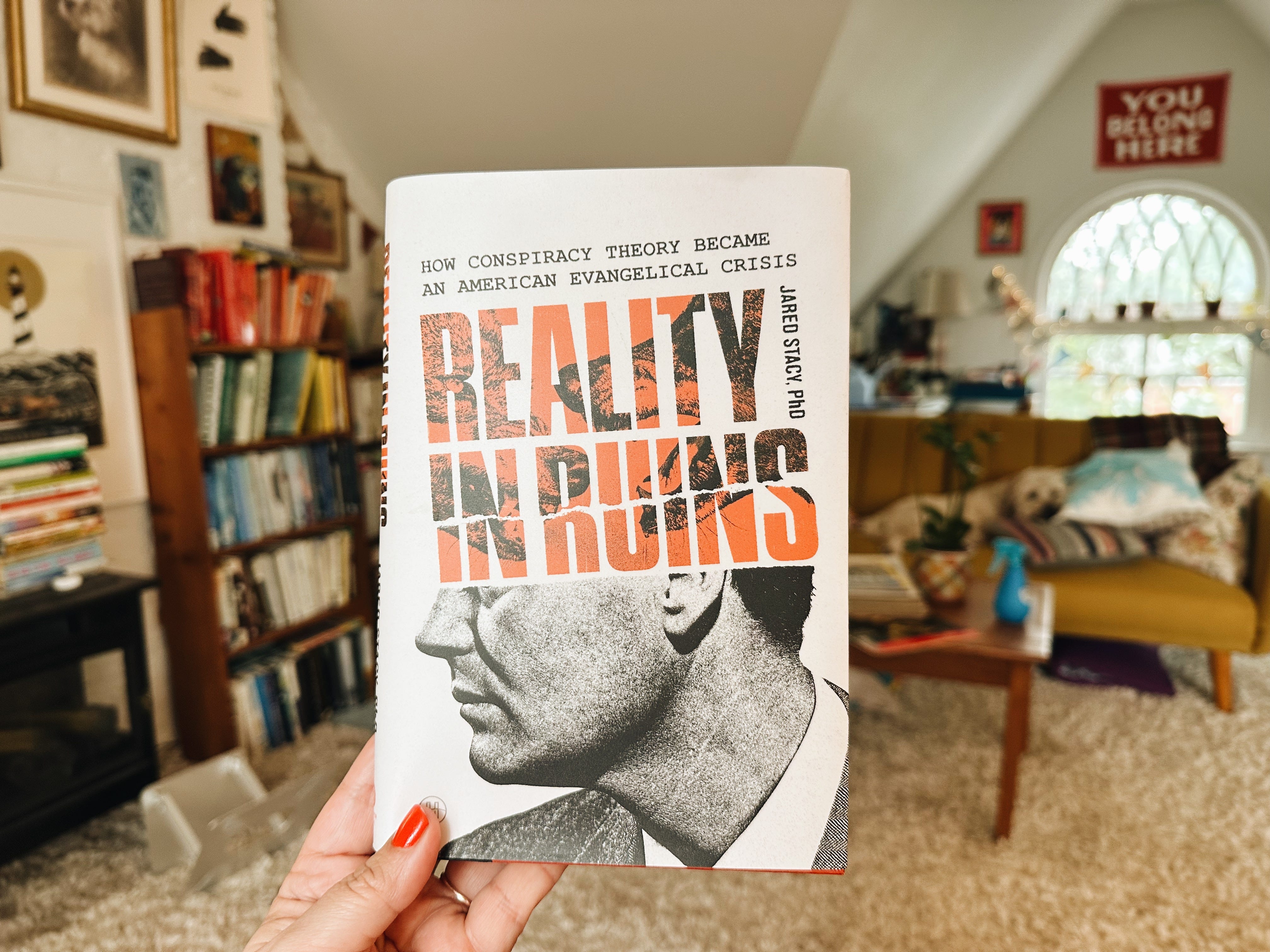
On an introduction to conspiracy:
“Conspiracy is a storytelling act that (1) claims what it cannot know and (2) goes beyond what it claims. Conspiracy theory reveals secrets and spins reality.”1
“Pain has forced many of us to seek answers for the loss and the loneliness. Conspiracism isn’t an academic problem to be solved in order to ‘fix people.’ It isn’t a disease that demands clinical intervention. It’s an act of storytelling that attempts to express the inexpressible, to channel fear into certainty, to narrate the complex by rendering it simple. This appeals…because we are human.”2
“Facts and data—far from being unquestionable—often function as mere raw material selectively used to affirm (rather than challenge) the operative or prevailing totality and the stories that construct it. If you believe your perspective is ‘biblical’ and your people are ‘right,’ then you can never be wrong—the danger, not just for the practicing Christian faith but for our common life, is obvious.”3
On American history & culture
In the middle of his fascinating chapter on our predilection to conspiracies throughout American history, he dissuades many preconceived notions about men like Cotton Mather, George Whitefield, Billy Sunday, and more. Not to simply dismantle the mythology around these men, but to help us understand why the stories they told (about the world, about themselves, but most crucially about God) linger in our ethos still. He writes:
“The basic framework of a conspiracy-busting gospel to assuage conspiratorial anxiety is with us still. The basic impulse that a revival will also reinstate the social order is, at its most basic form, the continuation of this legacy…[but] there is little reflection on aspects of social order that must change. Among the vocal, prominent public evangelicals is only the anxiety and paranoia over the collapse of order…there is little thought given to the injustices that permeate the order that various conspiracies threaten to destroy.”4
“This ‘end times’ theology, or more properly ‘eschatology,’ proved to be a significant power source for [charge.]. History became a code, and the Bible, the key. Reading the Scriptures in this sense did more than ascribe meaning to history; it offered certainty and specificity—insight into the unfolding events themselves.”5
“Conspiracism provides a shortcut from moral deliberation that trades on moral zeal.”6
On the possibility of a better way:
“Leading up to our time, novels like Left Behind and Hal Lindsey’s The Late Great Planet Earth shaped how evangelicals approached the Bible like no other academic work in the twentieth century. Their popular commitment to dispensationalism primed wide swaths of the American population to recognize in conspiracies the same sort of knowledge they believed was hidden in their Bibles, too. But it’s not just how evangelicals came to read the Bible. It is also how evangelicals think about the Bible. By deploying new terms like ‘inerrancy’ and ‘infallibility’ to describe the Bible, evangelicals have constructed a dogma of the Bible. They emphasize the authentic of the written document as a way to establish the authority of the Bible. This comes at the expense of recognizing Jesus as the living Word of God.”7
“Faith confesses Jesus is reality, and reality is Jesus. And what makes this reality different from our totalities is that it not one that we construct. Reality comes to us in Jesus as something we receive. It is no longer up to us to secure by any means, let alone violence. This is liberation, salvation, good news.”8

I’ll leave it there for now, but there is plenty more in the final chapters. Jared did a great job with this book and I’m happy to include in the work of undoing the damage of growing up in a world where conspiracy theory was common and the vernacular of it was threaded through my own journey with faith (and, I suspect, doubt).
I hope you’ll grab a copy of his book. If you need a place to purchase from, I recommend using this link where your purchase helps support local independent bookstores like mine, Nooks.
If you’re reading this in email (which 98% of you do!), consider pressing the heart (♡) at the bottom or top of this email. It helps my work get more eyeballs on it, which is nice for me and kind of you!
Reality in Ruins, Harper One, 2026, pg 11
pg 18
pg 54
pg 94
pg 103
pg 151
pg 168
pg 203
Thanks… I love how you invite us to explore and discover! What a gift in the world that seemingly likes… (demands??) to tell us what we should know /believe! Bless you!
I read this book earlier this year and was fascinated by it, too.