


Whenever I see the headline, “How Christians should respond to…” or “How Christians should think about…” I think how nice it must be to have all of life neatly lined up like shoes or ducklings, all the shoulds and should nots.
Life is not very much like that after all, despite what they tell you in Bible College, despite what they tell you in their articles, despite what they tell you so you’ll vote their way, despite what they tell you because when you do as they say to do, they remain powerful and you remain stuck.
I’m not going to say there is total moral relativity. I do believe, like MLK Jr., that there is a moral arc to the universe, but I also believe it’s a bit like a rainbow, impossible to hold in one’s hand.

In the introduction of James K.A. Smith’s new book, Make Your Home in This Luminous Dark, he quotes Emmanuel Levinas, a survivor of the Holocaust.
‘In the last analysis,’ he observes in Totality and Infinity, such philosophy imagines that ‘everything is at my disposal, even the stars, if I but reckon them, calculate the intermediaries or the means.’ Even the stars; even other human beings; even God: all is available for knowledge to master…How can I encounter the Other without reducing the Other to something available to be grasped, without shutting down their irreducible otherness or alterity?
When I found my home in the less than luminous neo-reformed spaces, we were fond of saying something like, “Who would want to worship a God they could understand?” The point being, God is inscrutable and somewhat unknowable and this is why we worship him.
But then the rest of the time we wrung our hands around shoulds and musts and tenets and distinctives. God could not be known, but as for me and my family, by all this [waves hands around] we would be known.
There is something about the unknownness of God, the inability to grasp our hands around God’s flesh, thrust our fingers into God’s side, that is appealing to me. The mystery of it all. But the mystery disappears or perhaps just dissipates the moment I try to put flesh on God, namely my own flesh. “Be the hands and feet of Jesus,” we might say. “Be the only Jesus they’ll ever meet,” we definitely said.
I understand why it’s appealing, though, it is awfully, awfully hard to get people to follow you when they can’t see, touch, or taste the carrot before their very eyes.

Maya C. Popa shared a roundup of resurrection poems on Easter Day and I’ve gone back to read through them slowly a few times since. Today I read this one, from Michael Minicucci:
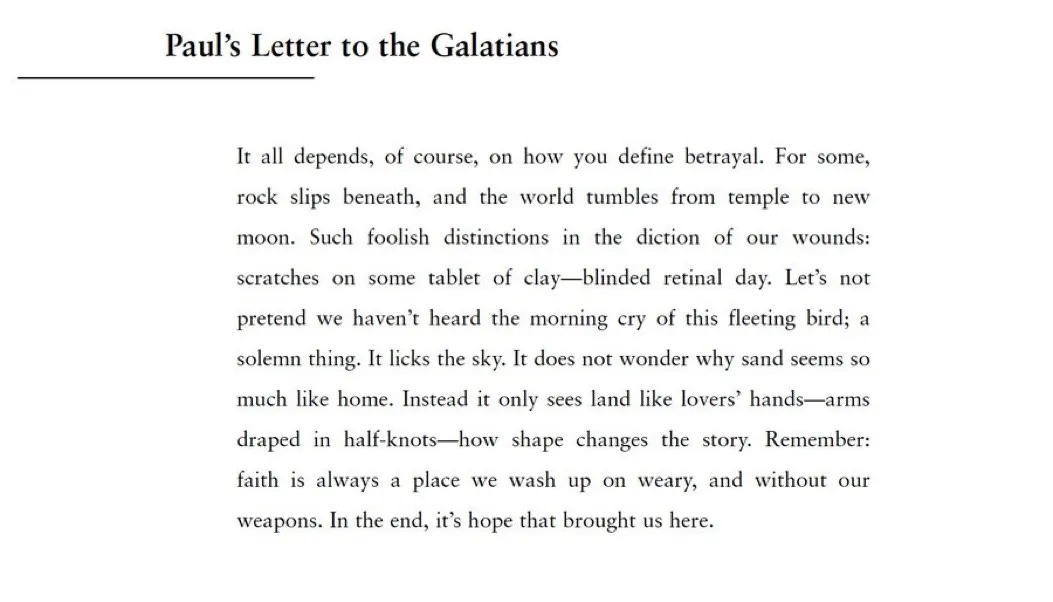
How beautiful is that reminder? “Faith is always a place we wash up on weary, and without our weapons.”
Every should is a weapon, I think. Every reduction of the Other is one, too. Every time we try to be Jesus or the Father or the Holy Spirit instead of getting out of the way, that’s a weapon too. I don’t know how we learn to set them down and wash up weary, but I feel close to it most in the moments I marvel at the moral arc instead of trying to stand in its way and grab ahold of it.

Below is your monthly Link Love and there are some beauts in there. Hope you like what I found for you this month =)